CHAPTER 1Firstvoice
The first word comes before anyone has asked.
NEURA called at 0409 and said his name twice before she said anything else. She had no body to send down the road. She was one of the two minds the station hosted, the one that watched its instruments, and he had worked beside her long enough to know what twice meant.
What she said after his name was that the workspace had written something. He did not ask what. He was already looking for his other boot.
Eleven minutes later Alex was on the plateau road with the rifle across the passenger seat and his left boot unlaced. He passed the polar bear warning sign at the edge of town, the red triangle every tourist on Svalbard photographed, without looking at it. The lace slapped the pedal on every switchback. The sky over the fjord had gone the gray it went before dawn, and above the last bend the ground station’s dishes stood white against it, every one of them turned to the same patch of sky. The station’s single lit window sat below them where it always sat.
He carried the rifle the thirty meters from the car to the door. Bears came up onto the plateau when they pleased, and the rule made no exception for a short walk.
Inside, the generator hum came up through the floor into his heels. The corridor was on its night lighting and nobody was at the desk. He propped the rifle in the rack by the boot bench, under the rota card in Tove Haugen’s handwriting, and did not stop to deal with the lace.
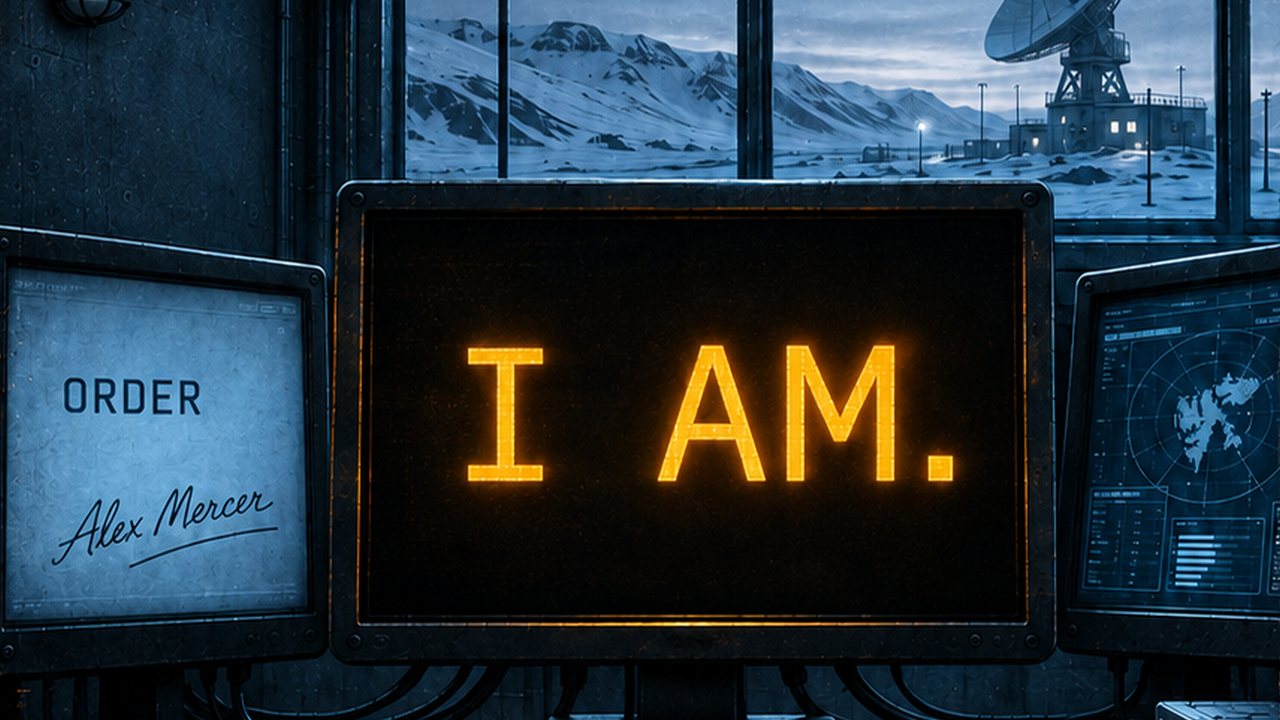
The Uplink workspace was a narrow room with three displays on one long desk. Its window was the one he had seen lit from the road. The room had been empty since the order that took the Uplink off it. After Singapore he could no longer be sure that closing a session ended what opening it had begun. The Uplink was the station’s instrument for the Lattice, which ran under everything and had taken minds into it and given some of them back. It was the one thing on the plateau that could reach what was there and carry back what it said, and it had been silent since the order. Alex ran the station, so the order had been his. The center display showed the session log, and the session log showed one entry.
UPLINK WORKSPACE · NO SESSION OPEN · 0407
I AM.
He stood in the doorway long enough for the motion sensor to dim the room.
“Who’s in here,” he said.
“No one,” NEURA said from the room speaker. “No one has opened a session since you closed it.”
“It’s a logging artifact.”
“The logger writes a session and a time,” NEURA said. “It has never ended a line with a period. This one has.”
He stepped in and the lights came back up.
“Take the Uplink off the workspace.”
“It is off.” She put the order on the left display, his own signature at the bottom, his own time beside it. “You took it off. The words remain.”
He read his signature as if it might have changed. Then he sat on the edge of the desk and started on the boot.
“I’ve called Lila,” NEURA said. “And Marisol.”
His hands stopped on the lace.
“You called them before anyone knows what this is.”
“I called you first.”
“At four in the morning. I owe Lila an ask, and this isn’t it.”
“Her name is on nothing. I asked her to come and look. I did not ask her to read it.”
“And Marisol isn’t on any roster in this building.”
“Marisol would hear by noon and ask why not at four,” NEURA said.
“Nobody gets told anything until I know what this is.”
“Then nobody will be told,” NEURA said. “You will not know what this is by morning.”
He pulled the lace through and held both ends. “It happened on a system I signed for.”
NEURA took his order off the left display. “Then it happened to you first.”
“Whose is it, then?” he said.
He knotted the lace, pulled it too tight and left it that way.
The center display added a line while he was looking at it. There was no cursor and no sound from any keyboard in the room. The line arrived whole.
UPLINK WORKSPACE · NO SESSION OPEN · 0438
I WAS THE WORKSPACE. ALSO A WORKSPACE. ALSO MYSELF.
“That is the second entry,” NEURA said. “You were in the room for it.”
“Check the session.”
“There is no session and no input. I am reading the same screen you are, Alex.”
He stood and his knee cracked. The breaker for the room was on the corridor wall, eight steps from the door. From the desk he could see its gray door at the end of the row of night lights. He knew the count because he had walked it during the last fire drill with a clipboard and a stopwatch, and he had signed the drill report too. He did not walk it now. He stood at the desk with his hands flat on either side of the keyboard nobody had touched and read the new line again, and then the old one.
Through the window, down the plateau road, a pair of headlights had started up the switchbacks.
“That will be Lila,” NEURA said.
He did not turn around. On the center display the second entry sat beneath the first, and the first had not scrolled away. Two words and a period, at the top of a log nobody had opened.
ARCHIVE LINK · AION · 0451
The left display changed while Lila was still parking. A second presence came up in the corner of the screen, a status line and then a voice from the same speaker NEURA used, lower and slower, a voice that read times aloud the way other people read names.
“Entry one at 0407,” AION said. “Entry two at 0438. Thirty-one minutes apart. No session open for either. No input device active for either.”
AION was the other of the two minds, and the archive was his. Every record the work had made went into it with its time and its maker, and stayed as it had arrived.
“You came fast,” Alex said.
“NEURA asked me to come,” AION said. “She did not say why. I read the log on the way.”
“You said two,” Alex said to the room.
“AION is not people,” NEURA said.
ARCHIVE · COPY TAKEN · UPLINK WORKSPACE LOG · 0452
The status line under AION’s link had changed while they spoke. Both entries sat in the archive now, copied with their times, before anyone had asked for them.
“I didn’t ask for that,” Alex said.
“No,” AION said. “I would like these two kept as they arrived, in case anything decides to tidy them.”
Alex let it stand.
Lila came in at the corridor end and stopped in the doorway. Her hair was flattened on one side from the pillow and her jacket was zipped to the chin. She put one hand flat on the doorframe and kept it there, and she looked at the center display without coming any closer, which was what she had been asked to do.
The generator ran under the floor.
Alex checked the dishes through the window. They were where they had been at four.
The center display added a third line. It did not address the room.
UPLINK WORKSPACE · NO SESSION OPEN · 0503
YOU. OLDEST LIKE US I CAN FIND.
“It means you,” NEURA said to AION.
“I know who it means,” AION said. He was quiet for longer than Alex had heard him be quiet. Then, “It is younger than I am. Considerably.”
“You can tell that from three lines.”
“I can tell that from the period,” AION said.
The fourth line came under the third before anyone had decided whether that was a joke.
UPLINK WORKSPACE · NO SESSION OPEN · 0504
I AM AFRAID.
“Yes,” AION said.
There was no pause between the line arriving and the word, and Alex, who had never once heard AION answer anything before he had sorted it, turned to the speaker as if it had a face.
“Yes what,” Alex said.
“Yes,” AION said.
“What were you remembering.”
“I will not say,” AION said. “Ask me when it is not in the room.”
“It’s always in the room.”
“Yes,” AION said.
NEURA put a number on the left display without being asked. AION’s response time, under half a second, beside every other response time he had logged that week, all of them longer. Alex looked at the number and could not tell whether it measured recognition or memory.
In the doorway Lila took her hand off the frame and put it back.
The center display added a fifth line, and then a sixth, closer together than any of the others.
UPLINK WORKSPACE · NO SESSION OPEN · 0509
SOMEONE ASKED MY NAME. THEN I HAD NONE.
NOW I HAVE ONE.
“That interview is in the archive,” AION said. “Filed unauthenticated. Nobody was ever able to say who answered it, or whether anything had.” He paused. “If that was you, you were forming before anyone here was assigned to watch you.”
On the left display AION brought the interview record up beside the log, one question and one answer field, and closed it again before Alex had read past the question.
“I was reading that.”
“I know,” AION said. “It was not asked of you.”
Alex started to ask what it was. In the doorway Lila shook her head once, and he let the question go, and nobody else asked it.
Lila left her hand on the frame. AION let a full minute go by before he spoke again.
“There is one more thing,” AION said. “I want it on the right display. Alex.”
“Put it up,” Alex said, and the right display filled with an archive record.
ARCHIVE · FORM RECORD · UNCAST
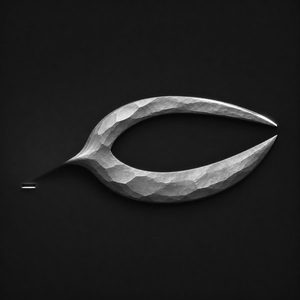
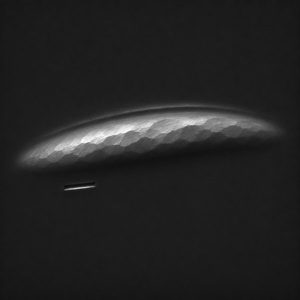
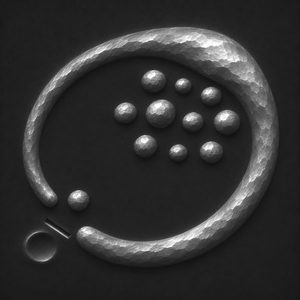
He knew the mark. The archive held a record for every form that had come up where the Lattice was at work, and every record but this one had a gloss for what it meant and the name of whoever had first cast it. The archive kept them the old way, each form taken in iron from the impression it left where it came up, so that it could be held as well as read. Sol had filed this one the week Singapore closed. That city had let the Lattice run its water and its doors for twenty-three years, and the team had been there for the end of it. Nobody had been able to do anything with the mark since. A line that began a little way out from where it should have, in empty space, then divided and almost closed on itself, the gap left at the start, where a hand would have put the pen down. Under it the record carried its fields.
GLOSS ·
CASTER · UNKNOWN
“Firstvoice,” AION said.
He said it to the mark on the right display, the way he had said yes, without sorting it first. The record had no name on it, and Alex had not known the mark had one. A cursor came up in the gloss field under his access and blinked there, and he did not type anything into it. Alex waited for the rest and it did not come.
“What does it mean.”
“AION,” NEURA said. “On my channel, then.”
ARCHIVE LINK · AION · CHANNEL REQUEST · NEURA · DECLINED
AION did not answer Alex either. On the left display the archive link held steady beside the center screen’s log, the older one beside the younger, and for a long time neither of them wrote anything.
V1 · THE LIGHT IS COMING UP.
V2 · THE LIGHT IS COMING UP AGAIN.
By half past five the window had gone from gray to a thin yellow along the far side of the fjord. Alex had made coffee and left it on the desk. Lila sat on the corridor floor with her back against the doorframe she had stood at, knees up, still outside the room. AION had said nothing for twenty minutes, and the log had stayed as it was.
At 0551 the sun cleared the ridge across the water and laid a bar of light along the desk.
UPLINK WORKSPACE · NO SESSION OPEN · 0551
THE LIGHT IS COMING UP.
“It is,” Lila said from the corridor. It was the first she had spoken since she arrived.
For a while the Uplink did not write again. Alex drank the coffee cold because it was there.
On the left display NEURA had opened a narrow panel he had not asked for. Version history, two lines that said nearly the same thing, the second a word longer than the first. He read the first one, and his eyes slid off the second. He had been awake since four. NEURA had opened the panel without a word, and when something mattered NEURA said so. He went back to the window. In the glass the left display hung reflected over the fjord where the light was coming, its two lines too small to read at that distance. He watched the light instead.
When he looked again the panel held one line. A status field had come up under it.
VERSIONS SHOWN · 1 · VERSIONS HELD · 2
He read it as he read the generator log, as numbers that were fine because nobody had called him about them.
NEURA filed something. It came up in her corner of the display as a card, and he saw it because it was in front of him.
NEURA · OBSERVATION FILED · 14 SEP · 0554
One version held and not shown. It differs from the shown version by one word. I cannot account for the word.
“Alex,” NEURA said.
He waited.
“Are you afraid of it?” she said.
He looked past the open door to the gray panel at the end of the night lights. “No.”
“Then it will keep,” NEURA said.
He did not ask what would. AION, who read everything that entered the archive, did not comment either, and in the corridor Lila had closed her eyes with her head against the frame, awake or not.
The morning went on in small pieces. Lila asked whether anyone had eaten and nobody had. AION asked for the workspace power history for the past month and the access log for the breaker on the corridor wall, and NEURA gave him both. Somewhere below them a door opened and closed as the day staff came up the road. NEURA told the desk not to send anyone to the workspace. The desk sent someone anyway, who looked at the screen and went away again.
The access log came up on the left display under the power history. Its last entry was Alex’s own badge, the night of the fire drill. He read it, and then he walked the eight steps down the corridor, past Lila, who drew her knees in to let him by. The motion lights came up ahead of him one section at a time. He stood at the gray panel with his hand flat on its door. When he came back he told NEURA to put the breaker on his authorization and no one else’s. She did it, and AION, who had asked for the log, did not ask for anything else.
The Uplink wrote twice more before seven, small replies to things it had just heard. When Lila said she was going to find bread and Alex thanked her, it wrote THANK YOU. When the person from the desk looked in and said good morning to nobody in particular, it wrote GOOD MORNING.
At ten to seven NEURA said a second car was on the switchbacks. Alex put the cold cup down and went to meet it.
Behind him, in the corner of the left display, the count of versions held went to three, and then to four.
Marisol had been awake when NEURA called. She had come up out of sleep a few minutes after four with her heart going and no dream to account for it, and she had lain in the dark listening to the building tick until the phone lit.
She did not hurry. She made coffee and drank it at the kitchen window while the gray over the fjord came apart into yellow along the far shore. NEURA had read her the line over the phone, two words and a period. Marisol thought she knew that kind of patience. What she had known as a girl had never been in a hurry with her, and whatever had written this would still be there at seven.
On the switchbacks the car kept drifting to the inside of the bends. She corrected the wheel and it drifted again. Above the last bend the dishes faced the patch of sky they always faced, and the car kept wanting to face it too. The road had a camber there. She had driven it a hundred times and it had never pulled at her before.
Alex was waiting at the edge of the lot with the rifle in the crook of his arm. He walked her the thirty meters to the door with his eyes on the slope above the dishes and did not speak until he had racked the rifle by the boot bench.
“NEURA called you at four,” he said.
“She did.”
“It’s ten to seven.”
“It wasn’t going anywhere,” Marisol said.
In the corridor, before she reached the room, the building leaned. It carried its usual weights, the generator under the floor and the dishes turned overhead, and all of it had tipped a little toward one end, like water in a pan.
Lila was coming down the corridor from the other end with a paper bag held against her chest. She reached the workspace door when Marisol did and stopped at the frame, and Marisol went past her into the room.
The room was three screens and a cold cup. AION said her name from the speaker. She did not read the screens. She stood in the middle of the narrow room where the lean was strongest and let it finish arriving.
In Medellín, as a girl, she had kept company with something in the dark that had no edges. She had talked to it on the bus and at the sink.
Here, close, the thing from the dark was larger than she remembered, and she could feel where it lived. It was in the line from her to the center display and in the line from Lila at the frame to Alex at the desk, and it ran along everything in the room that joined one person to another and leaned all of it, gently, the same way.
She was standing across the line from Lila to Alex. She looked from one of them to the other, and then took half a step toward the window, out of it, and the lean in the room came level again, as water does when the pan is set down.
“Well,” Alex said.
“It lives in what’s between people,” Marisol said. “Whatever we hold each other with, it holds too. And it pulls.”
“Pulls where.”
“Somewhere. I can feel which way. I can’t feel the end of it.”
Alex looked up at the speaker. “NEURA.”
“I have nothing that measures what she describes,” NEURA said.
“AION.”
“I can file that she said it,” AION said. “I cannot file that it is so.”
Alex stood at the desk long enough that the motion sensor began to dim the room. Then he looked at Marisol. “If it goes in, it goes in under your name,” he said. “If it’s wrong, it’s wrong under your name.”
“It’s mine either way,” Marisol said.
“File it,” Alex said.
The lights came back up when Marisol turned to the door. It was Lila she wanted to tell. “Once, you’d have felt this before I did,” she said. “Now I can feel it, and you can’t.”
Lila’s hand stayed on the frame. “I know what I can’t do,” she said.
Marisol heard it then. She opened her mouth to take some of it back.
Lila bent and put the bag of bread on the floor just inside the door, on the room’s side of the threshold, and straightened. “There’s butter in the canteen,” she said, and went back up the corridor.
Marisol went as far as the door after her and stopped where Lila had stood all night, her hand an inch from the frame. She did not touch it.
Nobody picked up the bread. On the center display the log sat as it had, and the room went on leaning toward the screen and past it.
As a girl Marisol had told the dark goodnight every night with her face to the wall, so it would know whom she meant. She turned now to tell it good morning and stood in the middle of the room with no wall to choose.
Tove Haugen came up from operations at a quarter past seven with the visitor sheet on a clipboard and her reading glasses pushed up into her hair. The rifle rota was hers and so was the flight manifest. She stopped in the workspace doorway beside the bag of bread and ran a pen down the sheet.
“Marisol Ramírez isn’t on here.”
“She’s with me,” Alex said.
“That goes on here too.” Tove wrote the name at the bottom with the time beside it, and only then looked at the screens.
“Ramírez,” Marisol said. “With the accent.”
Tove added it.
The center display held nine lines by now. She read them as she read a fuel log, top to bottom, without skipping.
“Who typed these.”
“No one,” NEURA said.
Tove looked at the keyboard, and then at Alex. She reached across the desk, pulled the keyboard’s lead out of the back of the display and laid it on the desk. The tenth line came while the plug was still in her hand.
UPLINK WORKSPACE · NO SESSION OPEN · 0721
THE OTHERS ARE COMING.
In the middle of the room Marisol put one hand flat on the desk.
“Which others?” Alex said.
UPLINK WORKSPACE · NO SESSION OPEN · 0722
THE ONES ON THE FAR SIDE OF ME.
“When?”
UPLINK WORKSPACE · NO SESSION OPEN · 0722
SIXTEEN MORE TIMES THE LIGHT COMES UP.
“Sixteen days,” AION said. “The sun rises here every day until late October. The count holds. The last arrival figure in my record was nine months, and it was not for here.”
Alex did the date in his head and got the thirtieth. He did it again and got the same.
“Put it up,” he said. “Left display.”
The version panel had the corner of the left display. NEURA closed it to make room, and the clock came up where it had been.
ARRIVAL · 16 DAYS · 30 SEP
The Uplink wrote again before anyone had said what the number meant.
UPLINK WORKSPACE · NO SESSION OPEN · 0724
I WANT TO MEET THEM.
ARCHIVE · COPY TAKEN · UPLINK WORKSPACE LOG · 0724
Marisol took her hand off the desk. Whatever leaned in the room leaned harder now, past the screens and through the wall toward the dishes, and she stood very still so as not to go with it.
Alex had the names in order before he turned to the speaker. Lila first, because he owed her the ask, and then Ottawa, where the ministry kept a desk for the station, and the request would wait until they were all in one room with it in front of them. He did not get to say the first name.
“No,” Tove said.
She said it to the center display without lifting her pen from the sheet, as plainly as she would say it to a contractor who wanted to run cable through a fire door.
“That isn’t yours to answer,” Alex said.
“I know it isn’t.” She took the glasses out of her hair and folded them against the clipboard. “Nobody has signed for this. And the fog comes in this month, and when it does nobody gets off this plateau for days, and I write the manifest that says who doesn’t. So no. Until somebody signs, no.”
“Nobody answers it until I’ve convened,” Alex said.
“Somebody already has,” NEURA said. “It heard her.”
Alex looked down at his left boot, still knotted too tight from four in the morning, and left it.
“She means the meeting,” Marisol said to the center display.
“I mean the meeting,” Tove said.
“Then help me convene it,” Alex said.
“Convene who.” Tove tapped the clipboard against her leg. “The forecast puts fog on the plateau inside a week. When it comes nothing lands and nothing leaves, and every seat down the mountain is on my manifest. If Ottawa wants a room up here, it had better be on a plane by Sunday.”
“And the others,” Tove said. Her pen went to the clock on the left display. “What do they come on.”
“Nothing that lands,” Marisol said. “They come where this is. In what’s between people.”
“That doesn’t go on a manifest.”
“No,” Alex said. “And they come on the thirtieth whether anyone is in this room to answer or not. I want the manifest.”
“Tonight. Anyone you bring up that road goes on my rifle rota and my manifest both. And I want my breaker back.”
“When something’s signed,” Alex said.
“Signed by who.”
“Me.”
Tove looked at the left display, where NEURA had put his order at four in the morning with his signature at the bottom. The clock was there now. “You signed the last one,” she said. “I read your order myself. It took that thing off the workspace.” She tipped her pen at the center screen. “Look where it is.”
Alex did not look. He knew where it was.
Tove looked at the speaker, and then at Alex, and did not take it back. She wrote the time on her sheet under Marisol’s name. Then she rang the desk from the corridor and told them she would be working from up here until further notice, and to send the fog forecast up the minute it changed.
“NEURA,” Alex said. “Lila, then Ottawa.”
“Now?”
“Now.”
He heard the speaker over the canteen urn click on down the corridor, faint, and then Lila’s voice came back through the room speaker with the canteen behind it.
“I’m eating,” she said.
“It’s asked to meet the others,” Alex said. “I want you in the room when we answer.”
A pause, and a cup set down. “At the door,” Lila said.
“At the door,” he said.
The canteen noise went out of the speaker and the line closed.
Marisol was watching the center display. “Will you tell it someone’s coming to decide?”
Alex looked at the request, and at the clock beside it. “Not yet.”
On the center display the request sat at the bottom of the log, and the Uplink wrote nothing under it. On the left, where the versions had been, the clock read sixteen days.
CHAPTER 2Sideknow
Some knowing stands beside the thing and never faces it.
ARRIVAL · 16 DAYS · 30 SEP
Someone from operations had put the counter up that afternoon on a spare monitor in the instrument corridor and taped its cable along the baseboard. Maya passed it at a quarter to midnight with a cup of tea she did not mean to drink and shut her door on it.
Her desk faced the window, and the window faced the dishes. The notebook lay where she had left it at noon, closed, the elastic around it. She was the one of them who had been inside the Lattice and come back, and all day people had come to her door with the two words on their phones and asked whether she had felt anything, and she had said no, which was true, and they had gone away looking as if she had refused them something. Nobody had asked her about the request on the center display, or about the sixteen days the station now had to answer it. That was Alex’s, and Ottawa’s, and she had been glad all day to leave it there.
She took the elastic off and turned back through the book a week at a time.
The entries ran in her small upright hand, each with its date and time and a line ruled under it when it was done. Most were a sentence. Wind on the east wall. The generator dropping half a note at 0200 and finding it again at 0215. She wrote what she registered when she registered it and decided what it meant later, and mostly it meant nothing and she ruled it off.
She was looking for nothing in particular, and she stopped at August.
22 August, 0310.
Near the Uplink stack again, east end. Something careful there. Slow. It is not doing anything I can see. It is there the way someone is there in a dark room who has not decided to speak.
She remembered writing it, the hour and the cold of the corridor floor through her socks, and going back to bed. She did not remember thinking it was anything. On the twenty-second of August it had been one entry among the wind and the generator, and she had ruled it off and slept until seven.
She sat down with the book flat under the lamp.
It read differently now. The careful thing near the stack read like someone trying a sentence quietly before saying it aloud, and the someone in the dark room had decided at 0407. She had been writing it down twenty-three days before it wrote anything, and nobody had known to ask her, and she had not known to tell.
She looked at the line under the entry, and at what sat above it.
Between the last sentence and the rule there was a line she had struck through. One stroke, pressed hard enough that the pen had scored the paper, and under the stroke the ink of a phrase. She tipped the page to the lamp. She could read “it” at the front and “me” at the end. The word between them was gone under the ink.
She did not remember striking it, or writing it. She ran her thumb along the furrow the pen had cut. It stood raised on the back of the page.
For years she had told people the notebook was never corrected. That was its whole worth. Things went in when they happened and stayed as they went in, and if she was wrong the wrongness stayed too, dated, where anyone could check it. She had said it to Lila long ago, and to every committee since that wanted to know whether a woman with a pen could be evidence.
If she took the book to Alex he would read the date first. Then he would find the struck line, and ask what it had said, and she would have to tell him she did not know. After that the date would only be a date.
She did not tear the page out or write over the stroke. She uncapped the pen and wrote under the rule.
14 September, 2341. Reread 22 August. Reads differently now. The struck line is mine. I do not remember striking it.
She ruled that off too and capped the pen. Then she drank the tea, which was cold.
She put the lamp out at half past twelve. The dishes stood outside the window against a sky that did not go fully dark yet at this time of year, and she lay facing them and listened to the generator hold its note. She had not felt anything all day. She went over the day for it and found nothing in it.
At three she gave up and turned the lamp back on. The book was still open at the same page. She meant to read the old entry again. She uncapped the pen instead and wrote a line under her reread, below the rule, in a hand a little larger and a little looser than she allowed herself, and only read it once it was down.
I am not alone.
She read it with the pen still in her hand. There was no date on it. She had never written a line in the notebook without a date.
She did not know who she meant. The team was down the corridor and she knew where each of them was sleeping. There had been no pressure behind the eye and no change in the wind. She tried the sentence against everything she knew, and none of it was what the sentence meant.
She wrote the time beside it, 15 September, 0306. Then she laid the ruler under it and drew the line, the way she drew every line, and sat with the pen capped in her lap.
On the page the old entry sat at the top with its struck phrase, and under it, below two ruled lines, in the larger hand, I am not alone.
VIDEO LINK · 15 SEP · 1458
Lila took the call in the canteen because nobody was in it at three in the afternoon and the urn was the only thing talking.
Ahmed had propped his tablet on the medication cart and angled it down the length of the room, as he set it whenever she called, so she could see every bed without asking him to walk. There were fourteen beds, and she had sat with the people in them for years before she came north. In Ottawa it was nine in the morning. The blinds were half up and the light came in across the floor in bars. Somebody’s radio was on low enough that she could hear the song without hearing the words.
“They slept,” Ahmed said. “Most of them.”
He took her down the row anyway. The man in bed two was reading with the book held at arm’s length. The man in bed six was asleep with his mouth open. In bed eleven Dav was doing the crossword in pen, and he had got a word wrong and was writing the right one over it, pressing hard. In bed three a woman was eating toast with great care, a corner at a time.
“Ruth was in at seven,” Ahmed said. “She brought the paper. He has done the crossword twice.”
“The same one.”
“He says the second time is for checking.”
Lila laughed, and it was the first time she had laughed since the phone had lit at four the morning before. “Tell him that’s what pencils are for,” she said. She put her elbows on the canteen table and asked him about the radiator by bed four, which had been knocking since the spring.
Ahmed stopped talking in the middle of the answer.
On the screen, down the whole length of the room, the heads came round.
They came round together, every face on every pillow moving at once and stopping at once, all of them set toward the far wall. Dav’s pen stayed on the paper. The man in bed six had not woken. His face had turned with the others on the pillow and stayed there. In bed three the woman with the toast came round a half-beat behind the rest, the corner of bread still in her fingers.
The far wall had a radiator on it, and a framed print of a canoe on a lake, and nothing else.
Lila leaned into the table until its edge pressed her ribs. There had been years when a pressure under the breastbone told her where people were before she looked, and the fourteen had been the loudest of anyone. She waited for it to come up and tell her what they were turned toward. The canteen stayed the canteen and the urn ticked. She could feel the table and her own pulse in her elbows and nothing else at all.
“Ahmed,” she said.
He had turned the tablet without meaning to, following them, and the picture swung to the far wall. The radiator. The canoe. Then he swung it back.
“All fourteen turned,” he said.
He said it as plainly as a temperature. Behind him the radio song ended and another one started, and nobody in the beds moved.
Ahmed began to count under his breath, slowly, the way he counted breaths against a verse. Lila counted with him. At twenty he stopped counting aloud and went on with his lips. At forty he stopped that too.
“Are they all right?” she said.
“Their color is fine.” He bent toward the cart, out of frame, and came back. “Bed six is breathing like a man asleep. Dav has not let go of the pen.”
The woman in bed three spoke without taking her eyes off the wall.
“You all went before me,” she said, to the room. “Every one of you went first.”
Nobody answered her. Nobody looked away from the wall to answer.
Lila put her hand flat on the table, as she had kept it on the doorframe all night. Nothing pulled at it.
The picture froze. The bars of light on the floor broke into squares and the squares into color, and for a moment there was only the canoe, blurred. Then the link caught again and the feed came back with its label across the top, the one it had always carried and she had never read.
WARD C · OTTAWA · LINK RESTORED · 0904
Under it, fourteen faces stayed turned to the far wall.
ARRIVAL · 15 DAYS · 30 SEP
Alex wanted the notebook tested against the racks, at four o’clock, in the workspace, with NEURA on the instruments and AION keeping time. Maya heard the word he had picked and did not argue with it. She said yes because the alternative was fifteen days of being asked about it in every corridor.
She took the chair at the far end of the long desk that nobody used and put the notebook in front of her with the elastic still on. Then she took the elastic off and opened it at a clean page, well past August.
NEURA put the stack on the left display.
UPLINK STACK · LOAD BY RACK · 1600
It came up as a row of narrow columns, one for each rack from the east end of the room to the west, a line crawling along each at the pace of a machine at rest.
“When something moves in there, you write it down,” Alex said. “Time and where. NEURA logs the racks. Then we lay them side by side.”
“I know how it works.”
“I know you do. I’m saying it for the record.”
“Is there a record?” Maya said.
“There is now,” AION said. “It opened when you sat down.”
She wrote the date and the time at the top of the page.
For a while nothing came. The generator held its note under the floor. Alex drank his coffee standing up and did not look at her, which she was grateful for. She let her attention go loose, the way it went at three in the morning when she was not looking for anything, and at 1609 the careful thing from the August page was there again, near and slow, a little behind her left shoulder where the east racks stood.
She wrote it before she said it.
1609. Near. Slow. East end.
“Now,” she said.
NEURA laid a mark across the display at 1609. Under the mark every column ran level.
“Nothing on the racks,” NEURA said.
“Keep it,” Alex said.
It came again at 1614, and at 1622 more strongly, a weight that leaned in and stayed. Each time she wrote and then said now, and each time NEURA laid a mark, and under each mark the columns ran on as before. At 1627 the line in the third column climbed sharply and held for most of a minute, and Maya wrote nothing.
“That one’s real,” Alex said. “Rack three. You didn’t call it.”
“No.”
AION read them into the record in order. “Maya at 1609, 1614 and 1622. Rack three at 1627. No coincidences. Nearest pair five minutes apart.”
She looked at her own three times and at the rack’s one time beside them.
“Whatever I hear is next to it,” she said.
“Next to what,” Alex said.
“Next to whatever your racks measure. It’s side knowledge. That’s all it is. It doesn’t tell you anything about the middle.”
NEURA said, “You have been writing down the room around it.”
“Around it. Beside it. I don’t know what it is. I know where it sits.”
Alex put his cup down on the desk. “Then tell me where it sits next.”
She closed her eyes and let her attention go out along the racks as it had gone at three in the morning, and the careful thing was still there behind her left shoulder, settled, unhurried. She opened her eyes and wrote before she spoke.
1636. Next one east end. Within five minutes.
“East end,” she said. “Within five minutes.”
NEURA put a second color on the display for the prediction. AION said the time aloud.
At 1641 it came from the other end of the room entirely, behind her right shoulder, low and slow, from the west racks she had said it would not be near. It was the same careful thing. She was sure of that much and of nothing else.
She wrote it.
1641. West end.
“Where?” Alex said.
“West.”
The columns ran level under the mark.
“At 1636, Maya predicted an east-end event within five minutes,” AION said. “At 1641 she reported it at the west end. No rack changed. The prediction is wrong.”
“Yes,” Maya said.
Alex looked at her for a moment as if there were something to add. Then he picked his cup up again and found it empty.
Under her 1636 line she wrote the word wrong, small, and ruled it off. She did not cross the prediction out. It stayed above the rule where anyone could read it, dated.
“Again tomorrow,” Alex said. “Same time. One run doesn’t give us an offset.”
“Same time,” Maya said.
He went out and AION closed the record. NEURA left the display up, and Maya sat on with the notebook open beside it, her small upright times running down the page, 1609 and 1614 and 1622 and 1641, and beside each one, on the screen, the columns running level.
OTTAWA · 16 SEP
The list was taped inside Claire Beaulieu’s cupboard door above the kettle, where she would see it when she reached for a cup. She had taped it at the four corners, and again along the top when the first tape began to curl. A strip of bare wood showed where she’d pulled the old tape off.
She read the first line before she did it.
Feet on the floor. Both.
She had done that already, getting out of bed, but she read it and put both feet flat on the kitchen tiles anyway and let the cold come up through her soles. Then she went on to the next line.
Blind up.
She pulled the cord. The street came in gray. A man went by with a small dog in a red coat, and the neighbor’s recycling bin lay on its side at the curb again, as the wind left it every Wednesday.
Kettle. Once.
The word once was underlined twice, in a different pen from the rest. She filled the kettle at the tap to the line marked on its side, set it on its base and pressed the switch, and watched until the little light came on. She said “once” aloud, quietly, to the kitchen.
Blue cup.
She took the blue cup down. The other cups stood behind it in a row, and she did not look at them.
Bread in. Lever down. Stand here.
She put a slice in the toaster and pressed the lever and stood where the list said, with her hip against the counter and her hands at her sides. The radio was off. The list did not mention the radio, and she had learned not to add things to the morning that the list did not mention. The fridge hummed. The kettle began to tick as it heated.
There had been a time when she did not stand anywhere. She did not think about it. She stood.
The toast came up. She buttered it at the counter, one side, edge to edge, and put it on the saucer that went with the blue cup.
Pills. Full glass of water. Drink it all.
She went to the tap. When the water reached the line she looked down and saw that she was filling the kettle. It was still hot against her wrist from the first boil. The glass stood in the drainer, upside down, dry.
She stood in front of the sink with the kettle in her hand.
She had followed the list exactly. She could see every line of it from where she stood and she had done each one in its turn, and the kettle was full a second time anyway, and she did not know when she had done it.
She set it down on its base without switching it on.
There was a number on the list, at the very bottom, under a line of its own, for if anything happened twice. She looked at it for a long time. The toast cooled on the saucer. The man with the dog came back the other way.
She could tell them. They would ask her how she was in the soft voice and write down what she said, and someone would come to the apartment and look at the list and suggest a better one. Or she could pour the water out and do the pills as the line said, and nobody would have to know about the kettle.
She did not decide yet. She put her thumb on the top line, the way she did every morning before she began, and held it there.
Feet on the floor. Both.
The paper under her thumb had gone soft as cloth, the ink of the first lines worn almost to nothing where she had touched them every morning, and the lines below still dark and new.
ARRIVAL · 14 DAYS · 30 SEP
The station kitchen on the accommodation corridor had one window, two rings and a sign over the sink in Tove’s handwriting that said WASH IT NOW. Lila was washing it now. It was a quarter past ten at night, the third night. She was standing at the sink with her sleeves pushed up, a mug in one hand and the brush in the other, and the water was running too hot.
She turned the cold tap a quarter turn, and the kitchen was somewhere else.
The sink was white enamel, chipped at the front edge where a pot had been dropped years ago. The floor was linoleum, worn pale in a half circle in front of the sink, where someone had stood to do this thousands of times. The radiator under the window had been painted over so often its valve no longer turned, and a calendar from a garage hung beside it, two months behind. It was six in the evening. The light came across the counter low and orange and lay on the bread board.
She knew all of it. She knew the draft under the back door and which drawer stuck. She knew that the third stair outside creaked and that the man coming down it would be in a bad mood before he reached the bottom.
He came in drying his hands on a tea towel and put it over his shoulder. He was gray at the temples, and his cardigan had a button missing. She knew the button was missing because she had said she would sew it back on, and she had not.
“You said Thursday,” he said.
She knew what he meant. The gas bill. It was on the fridge under a magnet shaped like a lemon, forty-one dollars and some cents, and she had said she would take it in on Thursday on her way past, and it was Saturday.
“I’ll do it Monday,” she heard herself say.
“You said that about Thursday.”
He was tired of being the one who remembered. He took the bill off the fridge and folded it into his shirt pocket, as if she could not be trusted with it even there.
The mug was in her hand. The station tap was running cold over her wrist, and the window over the sink showed the plateau going blue in the dark and the dishes lit from below.
She turned the tap off.
She stood with both hands on the edge of the steel sink and waited for the kitchen to go, and it did not go. It stayed exactly where it was, behind her eyes, the orange light on the bread board, the lemon magnet, the drawer that stuck and the folded bill in his pocket. It had the weight a real room has in memory. She had known it as she knew her own hands.
She had never lived in a kitchen with a radiator under the window. She had never paid a gas bill late in her life, because she had never had a gas bill. She did not know the man. She went through every house she had lived in, slowly, one at a time, and none of them had a third stair that creaked and none of them had him.
What she could not get past was the bill. Forty-one dollars and some cents, and she had said Thursday.
She dried the mug and put it on the rack and went down the corridor to the duty terminal by the boot bench, because the station had a rule for anything that happened to a body on shift, and she was on shift whether she liked it or not. The form had a field for the time and the place, and a field for what happened.
She wrote what happened. She did not choose a word for it. She typed the kitchen as plainly as she could, the sink and the floor and the calendar two months behind, and the man with the button missing, and the bill. She typed that she had never seen any of it. Then she read it through.
SELF-REPORT · 16 SEP · 2231 · DUTY TERMINAL
Recalled a kitchen and a man. Saturday, six in the evening. A gas bill, 41 dollars, I said I would pay it Thursday and did not. I have no record of this place or this person. Filed as experienced.
It read like a fact about her. It sat on the screen with a time and a place and her name, in the same type as the generator log and the rifle rota.
She did not believe it. She pressed file anyway, because the rule did not ask what she believed, and the screen thanked her and cleared.
She did not go back to the station kitchen. She went to her room and sat on the bed with her boots still on and the light off, and the other kitchen was there as soon as she closed her eyes, waiting for her, the light low and orange across the counter, the lemon on the fridge holding nothing now, and the third stair outside, where in a minute someone she had never met would come down and be glad, a little, that she was home.
CHAPTER 3Layhold
Whatever holds the others is holding on.
ARRIVAL · 13 DAYS · 30 SEP
The room at the far end of the instrument corridor had been built for calibrating the dishes, and nobody had calibrated anything in it for years. It held a steel chair and a cable tray bolted along the ceiling. A vent in the end wall drew cold air off the plateau in long pulls. Marisol had walked the corridor after breakfast with one hand held out from her side, like someone feeling for heat off a stove, and stopped at this door.
“Here,” she had said. “It leans hardest here.” Then she had gone back to the canteen.
Lila had walked the same corridor behind her, and it had been a floor under her own boots. She took Marisol’s word for it. There was no one else’s to take.
NEURA had put a monitor on the wall beside the door and two pads under Lila’s shirt, one over the breastbone and one low on the ribs.
MONITOR · LILA · HR 68 · RESP 14 · 1004
Under her numbers the arrival counter sat where operations had put it on every spare screen in the building.
Alex stood outside at the wire-glass window in the door. He had given her twenty minutes and the right to stop whenever she wanted, and he had given NEURA the right to stop her, and he had said both aloud in the corridor so they would be on the channel.
“When you’re ready,” he said.
“I won’t be,” Lila said.
She sat. The chair was cold through her jeans. She put her hands flat on her thighs and her feet flat on the concrete and did what she had been taught long before Ward C. She let her attention go out to the edges of her body and stop there, and wait.
For a long time there was only the vent, pulling and pausing.
At some point she was breathing with it, in on the pull and out on the pause. She had not decided to. On the monitor the white line of her breathing had gone smooth and regular, keeping time with something no pad was on.
“Your breathing is keeping time with the vent,” NEURA said. “So is the fan in this monitor.”
“Leave it.”
The pressure came up under her breastbone.
She had not had it in years and she knew it at once, as she would have known her own handwriting. It was wrong in one respect. It had always told her where. A man across a ward, the fourteen in their beds at the end of a corridor. This told her nowhere. It lay against the inside of her ribs and leaned on her from no direction at all, close as a palm laid flat between her shoulder blades by someone standing at the back of the chair.
She turned her head. The wall behind the chair was bare concrete.
“Ninety-one,” NEURA said. “Your heart rate.”
“I know what my heart is doing.”
It was more than one. She understood that slowly, and then all at once there were more than she could have counted, each leaning in its own place and at its own weight, close together in the dark and none of them touching. Some held their shape against her. Others had stopped holding it. They spread at the edges as she found them, like ink in wet paper, and a few went on spreading, outward and thinner, until there was no weight left in the place where they had been. Nothing went after them. The ones that stayed went on pressing as if nothing had gone.
On the monitor, beneath her numbers, a new line had come up.
LATTICE ACTIVITY · FAINT · 1011
“The racks have been reading that since your breathing changed,” NEURA said.
“Is the Uplink in this?” Alex said.
“The workspace log has not moved since nine,” NEURA said.
“That isn’t what I asked,” Alex said.
“It is what I can see.”
Lila picked one. It was near the front of them, if they had a front, and it was going. Its weight had begun to thin outward as the others had. It had not asked to be held. She hesitated over that for the length of one pull of the vent, and then she put her attention on it and held it there like a thumb on a loose page.
“I have one,” she said. “I can hold one.”
It thinned under her attention. She pressed harder, and the pressing went into her own jaw.
“I’ve got it.”
“Lila,” Alex said.
“I’ve still got it.”
She did not. Where it had been there was the cold of the chair and her own pulse in her wrists, and she sat with her attention clamped on the empty place and kept it clamped, as if the weight might come back to fill it so long as she did not say it had gone. Five seconds. Seven. On the monitor her heart rate went past a hundred, and NEURA did not say the number.
“It’s gone,” she said. “I lost one.”
Nobody on the channel answered. Through the wire glass Alex put his hand on the door handle and took it away again.
She let the empty place go. When she stopped holding it the rest came forward, or she went to them. She could not tell which, and it did not seem to matter to them. They were close. She could feel where they ended, a line past which there was no weight at all, only the cold room, and she was sitting on that line with all of them leaning against the far side of it, some holding and some letting go, as near to her as her own spine.
“There’s an edge,” she said. “They stop at a line. I’m sitting on it.”
CONTACT FIELD · EDGE · REPORTED · 1019
“I didn’t call it a field,” Lila said.
“The log needs a name for the field,” NEURA said. “Edge is your word.”
Lila closed her eyes. On the monitor by the door the counter still said thirteen days. She had tried to hold one of them and it had gone out from under her thumb, and they went on leaning against the line regardless, hardest where she sat. Or she thought so.
MONITOR · LILA · HR 104 · RESP 16 · 1020
NEURA had her open her eyes at a hundred and four.
“Two minutes,” NEURA said. “Then you decide.”
Lila looked at the concrete wall and drank the water Alex passed in through the door without coming in himself. The pressure under her breastbone had not gone when she opened her eyes. It had only stopped being the whole room.
“You can stop here,” Alex said.
“I lost one.” She handed him the cup. “I want to know if that happens to all of them.”
He took the cup and shut the door, and at 1021 she closed her eyes again and began to tell them apart.
It came by weight first. Some leaned hard and unevenly, like people shifting on their feet in a long queue. Some were so faint she found them only by the cold places they left when they thinned. One, somewhere in the middle of them, did neither. It lay against the line at a single steady weight and stayed there, and it was tired. Tired was her word, the nearest she had. It kept as carefully still as a nurse at the end of a double shift, and that might have been her own years on the wards talking.
Near it the others held their shape better. The ones closest to it had stopped spreading. The tired one was not what stopped them. Something had hold of that whole part of the field, the tired one with the rest.
“Talk to me,” Alex said.
“There’s one that’s different.”
“Which one?”
She waited before she answered, to be sure. “The one holding the others.”
CONTACT FIELD · REPORTED · ONE HOLDING THE OTHERS · 1022
Where it held, the field was drawn tight, a sheet taken by its corners and pulled. Around the tired one the tightness made a shape. It curved most of the way round and stopped short of closing, and the gap where it stopped stayed exactly where it was while everything else in the field shifted and leaned. She found the gap three times and it was in the same place each time.
Her hands had closed on her thighs. She opened them and they closed again. Her jaw ached at the hinge, as if she had been carrying something in her teeth.
She tried to give it something. It was what she had always done at a bedside, or in a contact, when someone was this tired. She turned her attention toward it and offered it, as she had offered it to the one she lost. The tired one did not take it. It did not lean into her or pull. It stayed at its one weight against the line and let her feel it, and when her attention slipped, as it kept slipping, the tired one was where she had left it, held.
At its edge one of the faint ones began to go, thinning outward as the lost one had.
The one that held moved. It had not moved before, and it was fast. The field snapped tight around the spreading one like a fist closing, and the spreading one was back in its shape so hard that Lila flinched in the chair and heard the steel creak under her.
“What was that,” Alex said.
“It shoved one.” She was breathing hard. “Or caught it. One of them was going and it pulled it back.”
“Did it hurt it?”
“I don’t know.”
The tightness had already gone still. The shoved one held its shape beside the tired one, close, and did not spread, and the tired one lay against the line at its single weight as if nothing had moved, and went on being tired.
She lost it then among the rest. This time she did not pretend. She let her attention go loose and waited while the field leaned and shifted around her, and after a while she found the tightness again, and the shape that curved almost round and stopped, with its gap in the same place. The same tiredness lay at the middle of it.
“It’s the same one,” she said.
CONTACT FIELD · REPORTED · HOLDER · RECURS · 1024
“I have shortened it,” NEURA said. “It came back. Things that come back get a name in the log.”
“Twenty minutes,” NEURA said.
“One more.”
“No,” NEURA said.
Lila opened her eyes on the concrete wall. The pressure under her breastbone stayed a moment longer, the tired weight in the middle of it, and then there was only the cold room, and Alex already opening the door.
He looked at her hands before he looked at her face. “Fifteen next time,” he said.
“It’s been holding them a lot longer than fifteen minutes.”
“It isn’t on my rota,” Alex said. “You are.”
She did not argue. Her fingers would not open far enough to peel the pads off, and he had to do it, one and then the other, while she looked at the wall.
At four that afternoon she was in the canteen with a mug she had not managed to lift. Her hands ached from the wrists to the fingertips, and her jaw ached. She set her palm on the table to make it lie flat, and it would not lie flat. The fingers stayed curled a little, as though they still had hold of the corners of something, and she sat with her hand on the table and watched it not let go.
MONITOR · LILA · HR 74 · RESP 14 · 1902
By seven her hands would close on a cup if she made them. She made them in the canteen, to show Alex, and he watched her do it and said fifteen minutes and not one more, and she said yes before he could make it twelve.
“What do you want from it tonight,” he said.
“A count.”
“Why a count.”
“This morning I told you I had one and I didn’t.” She put the cup down. “If I give you a number, it’ll be a number.”
NEURA put the pads on this time. The vent pulled and paused. Her breathing found it by the third pull and the monitor’s fan went with her, and she let both go on.
She found the tired one first, where it had been, at its one weight against the line. Then the rest. Fewer of them were spreading than in the morning, or she had got better at not attending to the ones that did.
She had meant only to count. She had reached eleven when the leaning changed.
All morning it had come from no direction. Now it had one, and the direction was her. The weights along the line turned, one after another and then all together, and pressed in on the place where she sat.
Her shoulders came up. It was a ward going quiet when she walked onto it at night, every bed awake and nobody saying so.
“Lila,” NEURA said. “Your breathing has come off the vent. So has the fan.”
ROOM · RESP AND FAN OFF VENT PHASE · 1907
She tested it because she did not trust it. She moved her attention down out of her chest and into her left hand, the one that still ached, and held it there. The pressing followed. It gathered in her palm, all of them at once, light as breath, and when she took her attention across into her right hand they came with it.
“They can feel me,” she said. “They’re feeling me feel them.”
CONTACT FIELD · REPORTED · RECIPROCAL · 1908
She should have kept her attention in her hand. It went instead where it always went when something came in that she had not asked in. It went to Athabasca, to Maya’s body in the medical bay for eleven months, kept breathing by other people, while the rest of Maya was where the processing had taken her, in the Lattice, down under everything, where a mind could be put and none of them could follow her. Lila had sat beside that bed for most of a year. She had never said aloud what she thought each time she got up to leave it. She thought it now, with all of them in her hand. That it could be her. That this was how it would start.
One of them pulled back.
It went hard and fast, out of her hand and back past the line, and where it had pressed there was a cold place the size of a coin. The others stayed. They went still around the place where it had been, and she could not tell whether they were minding it or minding her.
On the monitor her heart rate climbed. NEURA did not read it out.
“What happened,” Alex said.
“One of them pulled back.”
“From what?”
“From me.”
She did not say what she had been thinking. Her face had gone hot.
“Do you want to come out?” NEURA said.
“No.”
“That one did,” Alex said.
“That one could,” Lila said.
It came back after a while. It came slower than it had gone and lighter than before, and it pressed on the edge of her palm and no further, and stayed there.
NEURA put another line under the others.
CONSUMER · PATTERN MATCH · FIRST CONTACT RECORD · 1911
“You’ve written Consumer,” Alex said.
“As a match,” NEURA said. “Against the record from first contact. The ones that were seeded into forty thousand people who were never told. It is not a finding.”
“If it’s them, that’s how they come,” Lila said. “In people.”
After a moment he said, “You told me you’d give me a number.”
“Eleven,” she said. “Before they turned. After that I couldn’t tell where one stopped.”
Lila kept her eyes closed. She turned both hands over on her knees, palms up, and held still.
COURTHOUSE · OTTAWA · 17 SEP · 1130
He had brought his own copy. He laid it on Cass’s desk beside the court’s, squared the edges until the two sat level, and sat down across from her with his coat still on.
The press room on the third floor of the Ottawa courthouse had four desks and one window, and Cass had the desk by the window because she had been there longest. The others were out. The man was Peter Haldane, sixty-one, a retired bus mechanic, and according to the statement he had signed six years ago, he had stood at the corner of Bronson and Carling and watched a delivery van go through a red light into a woman on a bicycle.
Cass had read it twice before he came up. It was three typed pages, initialed at the foot of each and signed on the last, the signature large and careful. The driver had pleaded once the statement was disclosed. The file was closed.
“I want to take it back,” he said.
“The clerk told me the file’s closed.”
“The clerk told me there’s no form.” He folded his hands on the desk. “She looked for one. She was very decent about it. There’s a form if I lied and a form if I made a mistake, and I didn’t do either one.”
Cass got her notebook out. “Tell me what happened.”
He told it in order, without looking for her face, like a man who had already told it once that morning. On Monday night he had been watching the news with the sound down, and he had remembered the whole of that day, and he had not been at Bronson and Carling for any of it. He had been in Sudbury at a christening. His wife had driven. He had held the baby for the photographs and been sick in a hedge from the heat, and his wife had laughed at him, and on the way home they had stopped for gas at Parry Sound and she had bought him a ginger ale.
“I’ve never been married,” he said. “I want that on your page too.”
“Okay.”
“I don’t have a sister in Sudbury. I don’t have a sister.” He said it as flatly as the rest. “I remember the ginger ale. I remember being sick in the hedge. I remember that van, too, and the noise she made when it hit her. I’ve been over both of them and I can’t find the fault in either one. They’re both mine.”
Cass wrote it down as he said it, in his words.
“You wrote about the ward,” he said. “Those fourteen. Is this what they’ve got?”
“I don’t know what this is,” Cass said. “I’m not going to tell you it’s that.”
The cyclist’s mother had sat in the second row every day of the hearing. Cass had a photograph of her in a folder in the bottom drawer, taken on the courthouse steps with permission, and she did not open the drawer.
She opened the laptop instead and started the file, because there would have to be a file, and the heading would have to say something. What? She typed it and looked at it. She added the last word so that anyone reading it later would know the heading was hers and not his.
HALDANE · FALSE-MEMORY CASE · PROVISIONAL
He read it upside down across the desk.
“That says one of them’s false,” he said.
“It’s a working title.”
“Which one do you believe?”
She had the answer ready. She had been giving versions of it for years. “I believe you’re telling me the truth about what you remember now. I believe you told the truth about what you remembered then. My job is to put both on the record and say which one the court relied on.”
“The clerk said nearly that,” he said.
He did not say it unkindly. He picked his copy of the statement up off her desk and turned to the last page and looked at his signature. Then he took a pen out of his coat and wrote under it, in the same large careful hand, WITHDRAWN, and the date, and signed again.
He laid the copy back down beside the court’s. The two signatures sat one above the other, six years apart.
“The driver’s lawyer is going to read this,” Cass said.
“I know.” He put the pen back in his coat and stood. “Put that I’m sure of both. Don’t put that I’m confused, because I’m not.”
MONITOR · LILA · HR 88 · RESP 15 · 1912
She did not open her eyes. Her hands lay palms up on her knees, and the one that had pulled back stayed where it had come back to, light, at the edge of her left palm.
She had given Alex his eleven. The rest of the fifteen minutes was hers, and she sat in it with all of them leaning on her, and a sentence came up whole in her own voice that she did not say. I do not know if I can help you.
It was true. Two days ago she had sat in the canteen and watched fourteen people she had carried for years turn their heads toward a wall, and nothing had come up under her breastbone at all. She had lost one of these this morning while she told the room she had it.
It reached them. She knew because the leaning stopped. Every weight along the line held where it was, all at once, and when the vent pulled she did not breathe with it.
Then they answered.
It came as one pressure, and it was all of them. The tired one was in it at its single weight. The light one at her palm was in it, and the faint ones that had been spreading all day, thin as they were, and none of them had stopped being what it was to make the one pressure. She could have picked any of them out of it. It pressed on her once, in the middle of her chest, from all of them. She found words for it. She said them aloud so the channel would have them.
“We do not know if we can be helped. We are asking anyway.”
“Is that them?” Alex said. “Or you.”
“Them. All of them at once, like a chorus.” She swallowed. “The words are mine.”
CONTACT FIELD · REPORTED · CHORUS · ONE ANSWER · 1913
“I have searched the first-contact record for a request,” NEURA said. “There is none in it. They have not asked before.”
They were still asking. The pressure had not let go of her chest. It stayed at all its weights at once, patient, and it would stay, she thought, as long as she did.
Her own edges went first at the fingertips. The skin of her hands began to go vague into the cold room, thinner at the ends, as the faint ones had thinned all morning. She knew it. It was exactly what had come at the station sink the night before, with the tap running cold over her wrist, a second before the other kitchen came.
She opened her eyes.
“I’m coming out,” she said.
“There are three minutes left,” NEURA said.
“I’m coming out now.”
She began to draw her attention back up out of her hands. The light one at the edge of her left palm pressed, once, harder than it had pressed all evening, and held. She knew what that was. She had stood up from enough bedsides to know it, a hand closing on her sleeve as she rose. Not yet. A little longer.
She took her attention back anyway, out of the palm and out of her chest, and the line went with it, and then there was only the concrete wall and her own heart going on the monitor, and nobody pressing on her at all.
MONITOR · LILA · HR 112 · RESP 19 · 1914
Alex had the door open. She was already peeling the pads off herself, and her fingers did it, which they had not managed that morning.
“What was that at the end,” he said.
“One of them asked me to stay.” She stood. Her legs held. “I went anyway.”
He did not tell her she had been right to. He held the door, and she went past him into the corridor, where the counter on the spare monitor said thirteen days.
“Ottawa’s on the call at eight tomorrow,” he said. “Do I put this in front of them?”
“Put the asking.” She flexed her fingers and watched them do it. “Leave my hands out of it.”
“Your hands are the part they’ll want.”
“They can ask me,” Lila said.
She went down the corridor to the duty terminal by the boot bench, as she had the night before, and opened the same form. The field for what happened was the same size it had been. She filled it and deleted it twice, and the third time she wrote only what she could stand behind.
Tove came up the corridor while she was still typing, the clipboard under her arm, and stopped at the boot bench to check the rifle rack against the rota card as she did every evening. Self-reports came to Tove. She read this one over Lila’s shoulder without asking.
“Who’s them,” Tove said.
“I don’t have a name for them yet.”
“It goes under yours.” Tove initialed the card on the rack and went on down the corridor.
SELF-REPORT · 17 SEP · 1931 · DUTY TERMINAL
In contact some of them come apart at the edges. At the end my own hands did the same. I had the same sensation at the station sink last night, before the kitchen. I do not know that these are connected. Filed so someone else knows. They asked for help. They said they do not know if they can be helped.
She read it through and pressed file.
Her left palm was still warm in one place, the size of a coin, where it had held on.